
Whole Home Battery Backup Installation: The 2026 SoCal Guide to Energy Autonomy
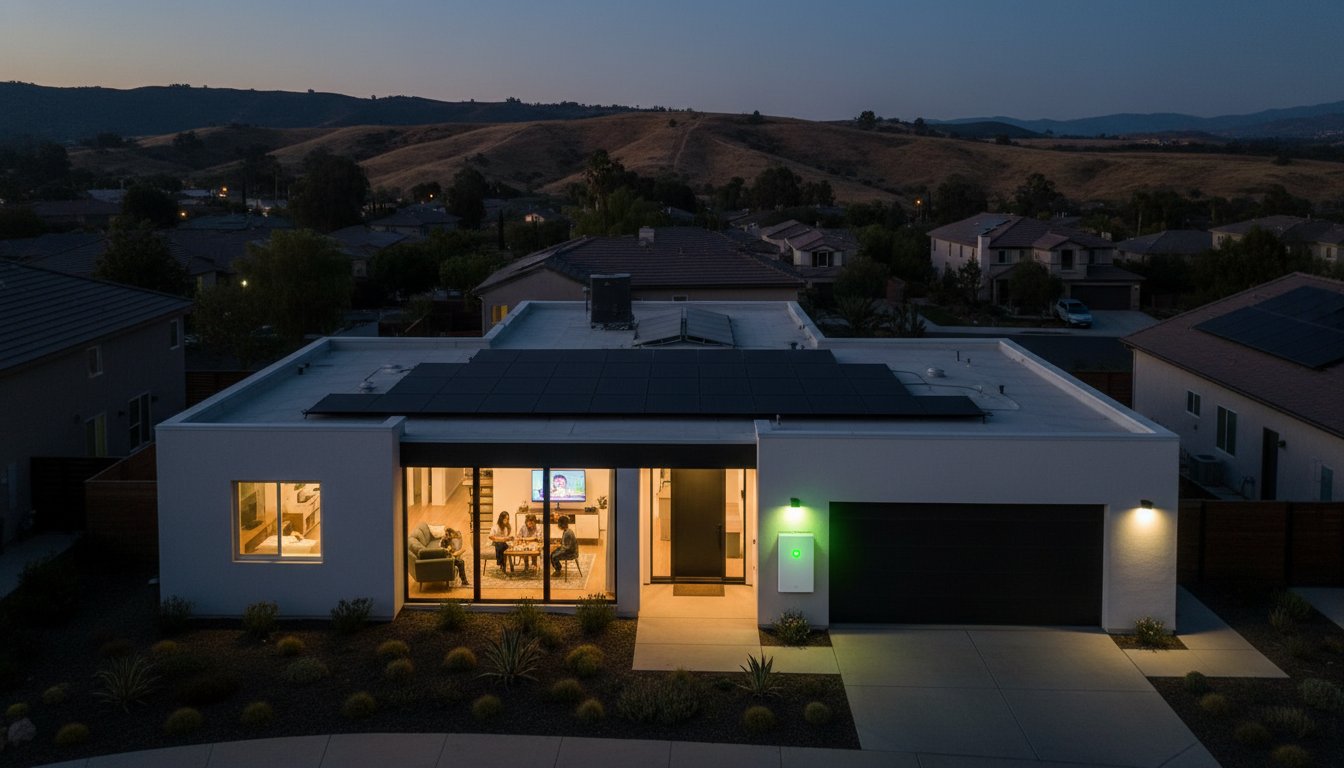
/
Article by
Jesse Malone
Jesse Malone
CEO & Partner, Underline Energy Concepts
Jesse Malone is the CEO and Partner of Underline Energy Concepts, a Southern California energy services company that has been serving homeowners since 2002. Since joining the company and becoming a partner in approximately 2015, Jesse has helped lead its growth into one of Southern California’s most trusted providers of residential energy efficiency and home improvement solutions.
Throughout his tenure, Jesse and the Underline Energy team have completed more than 2,500 energy upgrade projects for homeowners across Southern California. These projects include solar energy systems, roofing, battery storage, EV charging stations, electrical panel upgrades, water heater replacements, attic insulation, retrofit windows, and other energy-efficient home improvements designed to lower utility costs and increase property value.
Jesse holds a Bachelor’s Degree from California Southern University and brings more than 20 years of experience in emergency services through his service with the fire department. His background in public service has shaped his leadership style, emphasizing integrity, accountability, safety, and a commitment to serving the community.
A lifelong advocate for efficiency and practical solutions, Jesse is passionate about helping homeowners make informed decisions that improve both their homes and their financial future. His interests extend beyond energy efficiency into financial literacy, budgeting, investing, and long-term wealth-building strategies. He believes that reducing unnecessary expenses and maximizing efficiency are key components of financial success.
As CEO, Jesse continues to focus on delivering exceptional customer experiences, building high-performing teams, and helping Southern California homeowners achieve greater comfort, energy independence, and long-term savings through smart home investments.
What if your solar panels are actually leaving you vulnerable when the grid goes down? Many Southern California homeowners don't realize that without a whole home battery backup installation, their solar system automatically shuts off during a blackout to protect utility workers. It's a frustrating reality, especially when you're facing SCE rates as high as 38 cents per kWh and the complexities of the NEM 3.0 Solar Billing Plan. You've likely felt the anxiety of potential food spoilage or the fear of medical equipment failing during a summer heatwave. You deserve a system that works for you, not just the utility company.
This guide empowers you to master the technical and financial essentials of modern energy storage so your family remains powered and protected. We'll explore why Lithium Iron Phosphate (LFP) technology is the new safety standard, how to navigate the shifting 2026 tax landscape, and how to maximize your ROI before the state's property tax exclusion expires on December 31. By understanding how to leverage peak-shaving and local building codes, you can reclaim your financial autonomy and ensure your home remains a sanctuary during the next outage.
Key Takeaways
- Learn how to navigate the Solar Billing Plan (NEM 3.0) by shifting your focus from grid exports to self-consumption for maximum ROI.
- Compare LFP and NMC battery chemistries to ensure your system offers the highest thermal stability and longest cycle life available today.
- Master the technical steps of a whole home battery backup installation, from auditing your essential loads to assessing your main electrical panel capacity.
- Evaluate the maintenance-free benefits of battery storage over traditional gas generators to maintain a quiet, fuel-free home environment.
Why Whole Home Battery Backup is a Necessity in Southern California
Living in Riverside or San Bernardino County means dealing with a grid that feels increasingly fragile. Between extreme heatwaves and the constant threat of Public Safety Power Shutoffs, energy reliability is no longer a luxury. A whole home battery backup installation is a permanent, hard-wired energy storage solution that integrates directly with your electrical system. Unlike portable power stations, these systems provide a seamless transition the moment the grid fails. You won't have to run extension cords or stumble through the dark to find a flashlight. Instead, your home continues to function as if nothing happened.
The financial landscape for energy has shifted significantly with the implementation of the Net Billing Tariff, commonly known as NEM 3.0. In the past, you could sell your excess solar energy back to the utility company for a decent credit. Today, those export rates have plummeted. Storing your own solar energy is now mandatory if you want to see a real return on your investment. By utilizing home energy storage systems, you keep the power you generate. This allows for "Peak Shaving," where you draw from your battery during the expensive 4 PM to 9 PM window instead of paying record-high utility rates.
The Shift from Solar-Only to Solar-Plus-Storage
Many homeowners are shocked to find that their solar panels stop working during a power outage. This happens because standard solar inverters are designed to shut down to prevent "islanding," which protects utility workers from energized lines. Adding a battery solves this problem by creating a local microgrid for your property. As California utilities push everyone toward Time-of-Use (TOU) pricing, the timing of your energy use matters more than the amount. Energy arbitrage is a tool for financial control that lets you store cheap power and use it when the grid is most expensive.
Reliability for Medical Needs and Remote Work
For families in Menifee and Temecula, a blackout is more than an inconvenience. It's a risk to health and livelihood. If you rely on a CPAP machine, a home medical monitor, or refrigerated medication, a reliable backup system is a literal lifesaver. Remote professionals also face high stakes. A sudden grid failure during a critical meeting can derail a career. A whole home battery backup installation provides the "set-it-and-forget-it" automation you need to stay online. You gain the emotional peace of mind that comes from knowing your home is protected by a system that thinks for itself, ensuring 100% uptime regardless of what happens with the local utility provider.
Comparing Battery Chemistry and Capacity: LFP vs. Lithium-Ion
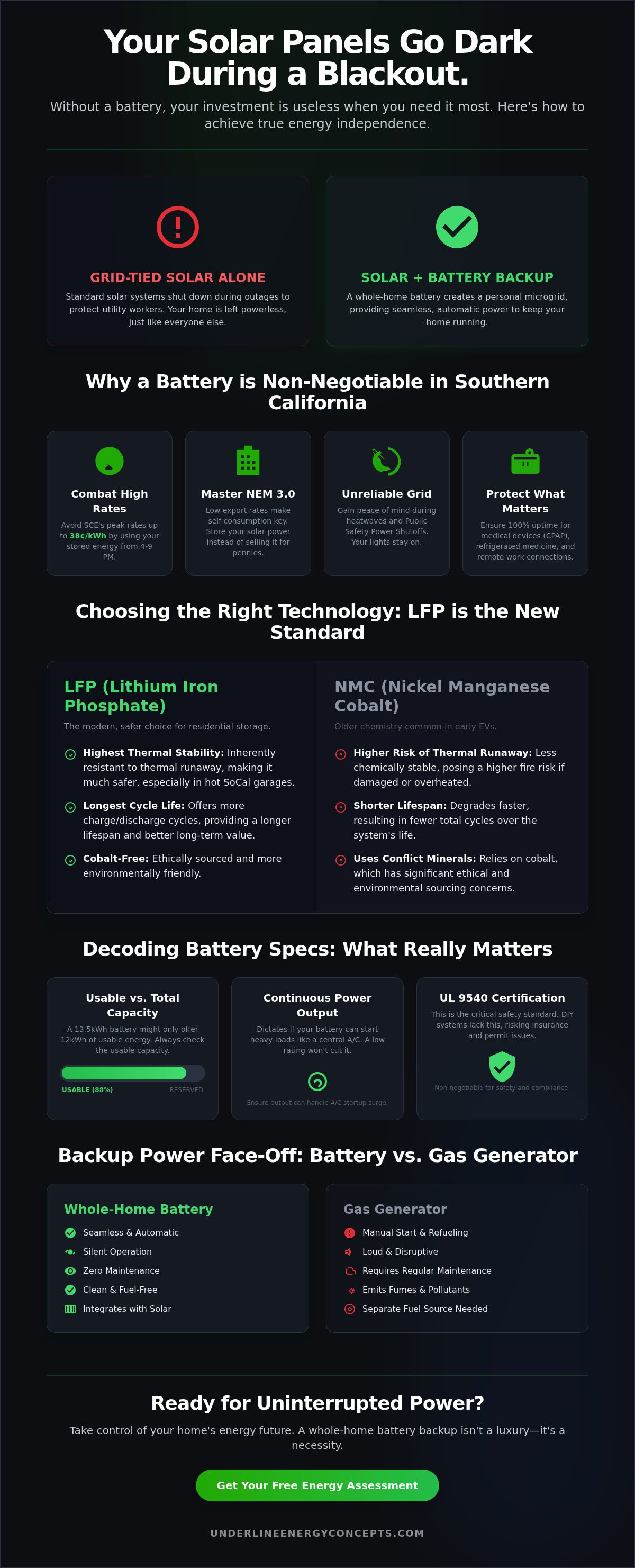
Choosing the right technology for your whole home battery backup installation determines how long your system lasts and how safely it operates. By 2026, Lithium Iron Phosphate (LFP) has become the gold standard for residential energy storage. Unlike older Nickel Manganese Cobalt (NMC) batteries commonly found in early electric vehicles, LFP chemistry is inherently more stable. It resists thermal runaway even under extreme conditions, making it the safer choice for Southern California garages where summer temperatures often exceed triple digits. While DIY enthusiasts on forums sometimes suggest building your own battery packs to save money, these custom builds lack the critical UL 9540 safety certifications required for home insurance compliance and local building permits.
When you evaluate different models, look beyond the flashy marketing and focus on "Usable Capacity" versus "Total Capacity." A system might be advertised as 13.5 kWh, but if the manufacturer restricts the depth of discharge to protect the cells, you may only have 12 kWh available for actual use. Even more critical is the "Continuous Power Output" rating. This number dictates whether your battery can handle the massive electrical surge required to kick-start a central air conditioner. To better understand how these components interact with your home's electrical grid, you can review government-backed data on home energy storage systems to see how they manage high-demand appliances during an outage.
Stackable vs. All-in-One Systems
Modular systems, such as those from Enphase, allow you to start with a smaller capacity and add more units as your needs grow. This flexibility is perfect for homeowners who plan to add an electric vehicle or a hybrid water heater in the future. In contrast, all-in-one units like the Tesla Powerwall offer a high-capacity solution in a single, sleek enclosure. Most Riverside homes find that 20kWh of storage provides the best balance for true autonomy, though a 10kWh unit can successfully keep essential lights and medical equipment running. If you aren't sure which configuration fits your specific energy goals, a professional load analysis can prevent you from overspending on capacity you don't need.
Cycle Life and Degradation: What to Expect
A "cycle" represents one full discharge and recharge of your battery. LFP batteries excel in this area, often providing between 6,000 and 10,000 cycles before showing significant capacity loss. A battery with 4,000 cycles can last over 10 years even with daily use. However, the intense heat of the Inland Empire can accelerate degradation if a system lacks robust thermal management. Quality whole home battery backup installation projects include systems with advanced heat sinks or liquid cooling to maintain an optimal operating temperature. This protection ensures your system meets its 10-year warranty requirements and continues to provide reliable power long after the initial setup.
Battery Backup vs. Gas Generators: Which is Right for You?
When the grid goes dark in communities like Canyon Lake, the difference between a house powered by a generator and one with a whole home battery backup installation is immediately obvious. It's the sound. While gas generators create a constant, mechanical roar that can disturb neighbors and violate HOA noise ordinances, battery systems operate in complete silence. This "Silent Advantage" allows you to maintain a sense of normalcy without the vibration or exhaust fumes associated with internal combustion engines. Beyond the noise, the response time is incomparable. Modern battery inverters switch on in under 10 milliseconds. This is so fast that your clocks won't even blink and your desktop computer won't reboot, a feat that traditional generators simply cannot match.
Maintenance is another area where these two technologies diverge sharply. A standby generator is a complex engine that requires regular oil changes, spark plug replacements, and fuel stabilization. If you neglect these tasks, the unit might fail exactly when you need it most. In contrast, a battery system relies on automated software updates and solid-state electronics. There are no moving parts to seize up and no filters to clog. While we offer both generator backup power and battery solutions, most Riverside homeowners are moving toward batteries to escape the chore of engine upkeep and the carbon footprint of fossil fuels.
Fuel Logistics and Reliability
Relying on a generator means your power is only as good as your current fuel stockpile. During widespread wildfires or earthquakes, gas stations often close or run out of fuel, making sourcing gasoline or propane nearly impossible. When you pair a battery with a solar panel install, you create an "infinite" fuel loop. As long as the sun rises, your "fuel" is delivered for free, directly to your roof. While a generator may have a lower upfront price, the ongoing costs of fuel and professional servicing over a 10-year period often make the battery a more financially savvy long-term decision.
Local Noise and Emissions Regulations
Southern California leads the nation in strict environmental and noise regulations. Many modern housing developments have specific bylaws that restrict the use of noisy machinery after dark. A whole home battery backup installation helps you meet these local green building standards effortlessly. Additionally, storing large quantities of gasoline or propane on your property carries a significant fire risk, especially in drought-prone areas of the Inland Empire. By choosing a battery, you eliminate the need for flammable fuel storage, reducing your home's risk profile while contributing to a cleaner, carbon-neutral community.
The Installation Process: Engineering Your Home for Resilience
A whole home battery backup installation is a sophisticated engineering project, not a simple appliance delivery. Leading specialists in high-performance design, such as Eastern Electric, emphasize that every component must be precisely integrated for optimal efficiency. The process begins with a detailed energy audit where we track your "Essential Loads" versus your "Whole Home" requirements. If you want to run your central air conditioner during a heatwave, your system needs to be sized for those heavy startup surges. Once the design is finalized, we handle the permitting process with Riverside County or your specific city building department. Unlike national telemarketers who promise "plug and play" setups in a week, we understand that local safety standards and utility Permission to Operate (PTO) protocols require methodical attention to detail.
The physical installation involves mounting the battery units, wiring the smart gateway, and commissioning the software that manages your power flow. This smart gateway acts as the brain of your home, deciding when to store solar energy, when to use it, and when to isolate from the grid during an outage. After the hardware is in place, we coordinate with the utility company for the final inspection. This step is critical because you cannot legally operate your system in parallel with the grid until you receive official PTO. We manage these administrative hurdles so you can focus on the relief of having a protected home.
Why Your Electrical Panel is the Foundation
Your main electrical panel is the heart of this entire operation. Many older homes in the Inland Empire have panels with crowded busbars or outdated equipment from brands like Zinsco or Federal Pacific. These older units aren't just inefficient; they're often incapable of handling the bidirectional power flow required for modern energy storage. We strictly follow the "120% Rule" in the National Electrical Code, which limits how much solar and battery power can be fed into your panel. If your current service is under 200 amps, an Electric Panel Upgrade is often the first step toward true energy autonomy. We integrate these upgrades into your project to ensure a seamless, code-compliant connection.
California Fire Codes and Battery Placement
Modern California fire codes have become much stricter to ensure resident safety. Your battery placement must follow specific proximity rules, typically requiring a three-foot clearance from windows, doors, and sleeping areas. If we install the system in your garage, we may need to include heat detectors and protective bollards to prevent accidental vehicle impacts. These regulations might seem like hurdles, but they're essential for keeping your home insurable and your family safe. Our team ensures every component meets these local requirements before the final utility inspection. If you're concerned about your current electrical setup, request a professional panel assessment to build your system on a solid foundation.
The Underline Advantage: Why Local Expertise Matters
Underline Energy Concepts isn't just another national solar installer. We live and work in the Temecula and Menifee communities. We understand the specific utility rate structures and building codes that affect your property. Our dual status as licensed roofing and electrical contractors allows us to take a "System Synergy" approach. We don't just hang a battery on the wall. We look at your entire energy envelope to ensure your whole home battery backup installation delivers maximum value. This includes integrating unique solutions like Quietcool Battery Charge Mounts to optimize your system's performance and longevity.
Accountability matters when you're making a long-term investment in your property. Because we're local, we provide transparent pricing and long-term maintenance support that national telemarketers can't match. You aren't just a number in a database; you're a neighbor. We take pride in building resilient homes that stand up to the unique pressures of the Southern California grid. Our team stays grounded in local values, ensuring every project meets our high standards for safety and reliability.
Integrated Energy Efficiency Upgrades
A battery is only as effective as the home it powers. If your house leaks cool air, your battery will drain faster trying to keep up with the HVAC system. By installing attic insulation and a whole house fan, you significantly reduce the load on your energy storage. This allows your battery to last longer during an outage. We also specialize in combining roofing repairs with solar and battery projects. This integrated approach saves you money on labor and permitting while ensuring one single contractor is responsible for your roof's integrity and your home's power.
Start Your Journey to Energy Independence
Your path to autonomy begins with a thorough consultation with an Underline specialist. We don't use high-pressure sales tactics. Instead, we listen to your goals and analyze your energy usage to build a custom solution. We handle all the red tape, including the complex SoCal utility paperwork and city permits, so you don't have to. Our goal is to make your transition to clean, reliable power as seamless as possible. You deserve the peace of mind that comes with true energy security. Schedule your whole home battery backup consultation today and take the first step toward a more stable future.
Take Control of Your Energy Future Today
Transitioning to energy independence is no longer a complex risk; it's a practical decision for any Southern California homeowner. You now understand how the shift to NEM 3.0 has transformed battery storage from a luxury into a financial necessity. By prioritizing LFP chemistry and professional engineering, you ensure your system survives both the heat and the utility rate hikes. A whole home battery backup installation provides more than just electricity during an outage. It offers a sense of relief and long-term stability for your family.
Underline Energy Concepts brings the authority of a licensed C-10 Electrical and C-39 Roofing Contractor to every project. We combine expert local knowledge of utility rate structures with a comprehensive 10-year workmanship warranty to protect your investment. Don't let external financial pressures or grid instability dictate your home's comfort. Secure Your Home Power with a Professional Battery Installation and join the growing community of autonomous homeowners in Riverside. Your journey toward a more resilient and cost-effective future starts with a single conversation.
Frequently Asked Questions
How long will a whole home battery backup power my house?
The duration of your backup power depends on your battery's capacity and your home's energy consumption. A medium system between 10 and 20 kWh typically covers most household circuits for 8 to 24 hours. If you choose a large system exceeding 30 kWh, you can power heavy appliances like air conditioners for longer periods. We size your system based on your specific needs to ensure you aren't left in the dark during a prolonged outage.
Can I install a battery backup if I don’t have solar panels?
You can install a battery system without solar panels to protect your home from grid failures. This setup allows you to charge the battery from the utility grid during off-peak hours when rates are lower and use that power during peak times. However, pairing it with solar is the most effective way to achieve true energy autonomy and maximize your long-term savings under the current NEM 3.0 rate structures.
Is a 200-amp panel upgrade required for battery installation?
A 200-amp panel upgrade isn't always mandatory, but it's often necessary for a seamless whole home battery backup installation. Modern energy systems require significant space on your electrical busbar to meet the National Electrical Code's "120% Rule." If your current panel is crowded or outdated, an Electric Panel Upgrade ensures your home can safely handle the bidirectional power flow of a high-capacity battery system.
What is the difference between essential load backup and whole-home backup?
Essential load backup focuses only on your most critical circuits, such as your refrigerator, lights, and medical equipment. This requires a smaller battery capacity and keeps your basic needs met during an outage. Whole-home backup is engineered to power every circuit in your house, including high-demand appliances like your central air conditioner and hybrid water heater. We help you audit your energy needs to determine which level of resilience fits your lifestyle.
Are there federal tax credits available for home battery systems in 2026?
As of January 1, 2026, the federal Investment Tax Credit for homeowner-owned systems has expired. For the 2026 and 2027 tax years, federal credits are only available for batteries installed through leases, Power Purchase Agreements, or prepaid arrangements. It's vital to check with a tax professional to understand how these specific 2026 regulations affect your financial planning and system ownership options.
How much space does a whole home battery system take up?
Modern battery systems are surprisingly compact and typically mount directly to your garage wall or an exterior surface. A single unit is roughly the size of a small water heater, though larger whole home battery backup installation projects may require multiple units side-by-side. We ensure the placement meets all California fire codes, including specific clearances from windows and doors to keep your installation safe and code-compliant.
Does a home battery require regular maintenance?
Unlike gas generators, home batteries require virtually no manual maintenance. There are no oil changes, spark plugs, or fuel stabilizers to manage. The system maintains itself through automated software updates that optimize performance and battery health over time. You simply monitor your energy flow through a smartphone app, giving you a "set-it-and-forget-it" solution for long-term home resilience.
What happens to my battery if the internet goes out?
Your battery system will continue to provide backup power even if your internet connection fails. The smart gateway is designed to operate locally, meaning it can still detect a grid outage and switch to battery power in milliseconds. While you might temporarily lose the ability to monitor your system through your mobile app or receive software updates, your home's energy security remains fully intact.